
3Dai™
AI-powered analysis for whole tissue 3D datasets
3Dai™ is the AI-powered analysis layer of the Aurora 3D Spatial Biology Solution. It segments biological features, measures spatial relationships, and generates quantitative outputs from intact tissue volumes.
From volume to quantitative biology
Extract measurable spatial information from intact 3D tissue architecture
Whole tissue imaging creates rich volumetric datasets, but interpretation requires more than visualization. 3Dai™ applies AI-powered analysis to help identify structures, measure spatial relationships, and generate quantitative outputs from 3D tissue imaging data.
The goal is to move from image volume to biological measurement. Segmentation, spatial statistics, pattern detection, and quantitative tissue analysis help make 3D datasets easier to interpret and compare.
Segment
Identify cells, structures, regions, or features inside volumetric datasets.
Measure
Quantify counts, distances, density, morphology, and spatial relationships in 3D.
Map patterns
Analyze clustering, feature interaction, and spatial organization across intact tissue context.
Report outputs
Generate quantitative tissue analysis outputs that support digital pathology and spatial profiling workflows.
AI and machine learning workflow
Build, train, and optimize models for large 3D tissue imaging datasets
3Dai™ applies AI and machine learning workflows to help extract consistent measurements from complex volumetric datasets.

Custom model development
Create AI models for specific research needs, supporting reliable analysis across defined tissue structures, markers, or biological features.

Model training and validation
Train and validate models to support measurement of spatial organization, feature relationships, and patterns in 3D tissue data.

Performance optimization
Fine-tune model performance for efficient analysis across large image datasets, including 10 to 100s of TB-sized 3D image data.
The workflow is designed to move beyond visualization alone, connecting AI model development with spatial statistics, pattern detection, and quantitative tissue analysis.
Spatial statistics in 3D
Measure relationships across intact tissue architecture
3Dai™ supports spatial profiling by measuring where features are, how they relate, and how patterns change across volumetric datasets.
Distance metrics
Measure proximity between cells, structures, regions, or marker-positive features in 3D space.
Density analysis
Quantify how features are distributed across tissue regions, volumes, and anatomical context.
Spatial clustering
Identify grouped patterns and regional organization across 3D tissue imaging datasets.
Feature interaction
Evaluate how different markers or tissue features relate across intact 3D architecture.
Analysis capabilities
Adapt analysis to the biology and study question
Extend established segmentation and spatial-statistics workflows with customized analysis strategies designed around the tissue, markers, biological questions, and quantitative endpoints of each study.
Custom spatial statistics
Develop study-specific measurements that capture biologically relevant relationships, regional variation, and tissue-level organization across intact 3D samples.
Multidimensional analysis
Integrate multiple markers, feature classes, structural measurements, and spatial readouts to examine complex biology across large volumetric datasets.
Pattern detection
Identify recurring biological structures, localized signatures, and tissue-wide patterns that may be difficult to recognize through manual review or isolated 2D sections.
Tissue-specific workflows
Configure analysis around the morphology, cellular composition, and structural organization of different tissues, disease areas, and experimental models.
Study-specific quantitative metrics
Generate quantitative endpoints aligned with the study design, treatment question, biological hypothesis, or translational objective.
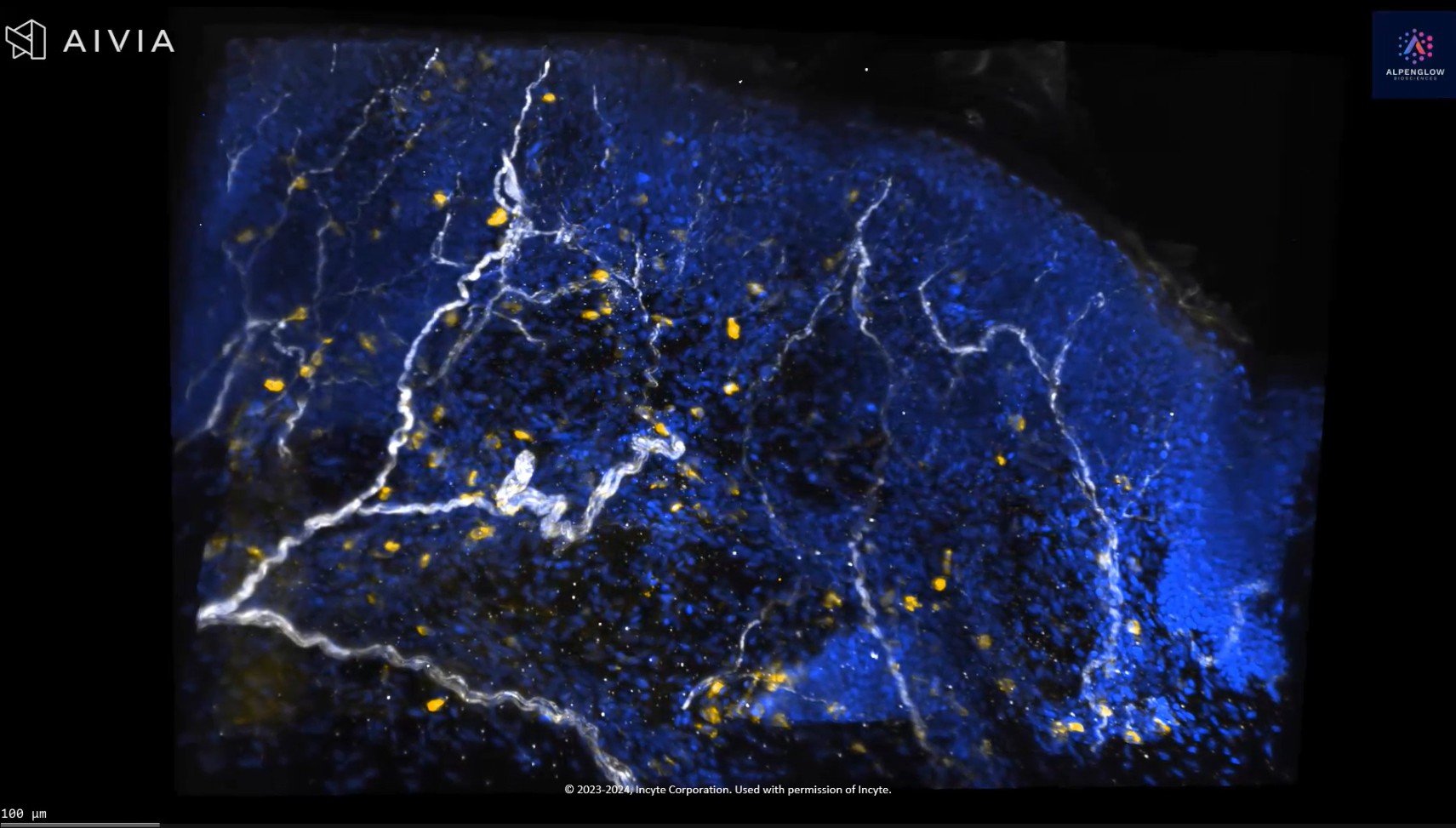
Analysis outputs
Convert 3D image analysis into deliverables teams can use
3Dai™ turns segmented volumetric datasets into visual, spatial, and statistical outputs that support digital pathology, spatial profiling, and quantitative tissue analysis.
3D segmentation maps
Identify cells, structures, regions, or marker-positive features inside volumetric datasets.
3D visualization videos and viewers
Support review and communication of tissue architecture, marker distribution, and spatial patterns.
Spatial statistics
Quantify distance, density, clustering, and feature relationships across intact tissue architecture.
Pattern detection
Summarize spatial organization, clustering behavior, and region-level patterns.
Statistical graphs
Support comparison across samples, tissue regions, marker panels, or study groups.
Custom analysis metrics
Generate measurements tailored to the biological question, tissue type, marker panel, or workflow.
From volume to measurement
Ready to extract quantitative biology from your 3D tissue imaging data?
3Dai™ supports the AI-powered analysis layer of the Aurora 3D™ Spatial Biology Solution, helping teams move from volumetric datasets to segmentation, spatial statistics, and quantitative tissue analysis.
Guided AI exploration
Want a more intuitive way to explore 3D analysis results?
Summit AI™ extends the analysis experience with a guided interface for exploring 3D tissue imaging results, spatial patterns, and quantitative outputs.